

| Unlocking Combinatorial Immuno-Oncology: Why Clone B20-4.1.1 is Essential for Preclinincal TME Research |

|
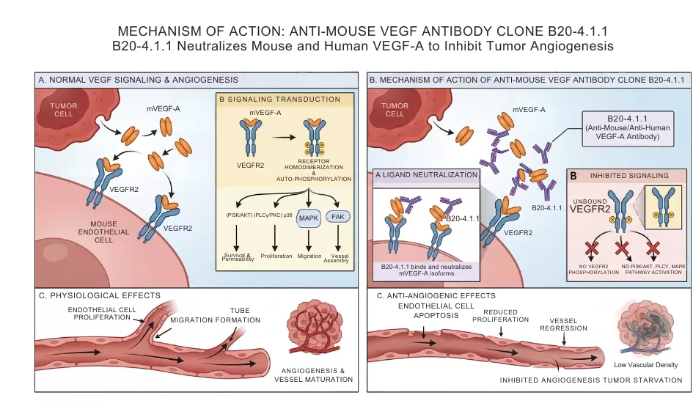
Why Clone B20-4.1.1 is Essential for Preclinical TME Research Vascular Endothelial Growth Factor (VEGF) is a primary driver of tumor angiogenesis. However, its role extends far beyond simply building new blood vessels to feed a growing tumor. VEGF is a potent immunosuppressor within the tumor microenvironment (TME), actively hindering dendritic cell maturation and blocking the infiltration of critical effector T-cells. Because of this dual role, targeting VEGF has become a cornerstone of modern cancer therapy. For researchers modeling these therapies in immunocompetent mice, Anti-mouse VEGF Clone B20-4.1.1 is the gold standard. What makes Clone B20-4.1.1 the preferred choice? Originally developed by Genentech, B20-4.1.1 is a highly potent, cross-reactive monoclonal antibody that acts as the preclinical murine analog to the blockbuster drug Bevacizumab (Avastin). It effectively neutralizes VEGF-A, halting angiogenesis and helping to "normalize" the tumor vasculature. The Power of Combinatorial Blockade with B20-4.1.1 Today, preclinical research rarely looks at anti-angiogenesis in a vacuum. Normalizing the tumor vasculature with B20-4.1.1 paves the way for immune cells to enter the tumor, making it the perfect partner for immune checkpoint blockades. B20-4.1.1 has been frequently cited with the following highly synergistic clones in syngeneic mouse models:
|
|
Recent Citations using B20-4.1.1 in vivo 1) Immuno-Oncology Combination Therapy (February/March 2026) Title: Digital spatial profiling reveals additive effects of triple therapy on tumor microenvironment: anti-PD-L1, anti-VEGF, and PARP inhibition in mouse models Journal: Cancer Immunology, Immunotherapy (and PMC12882906) How B20-4.1.1 was used: The researchers used B20-4.1.1 (dosed at 100 μg/mouse and 5 mg/kg i.p.) to block VEGF in immunocompetent murine models of colon adenocarcinoma (MC38) and ovarian cancer (HM-1). They found that adding B20-4.1.1 to their checkpoint blockade regimen significantly enhanced the infiltration of cytotoxic CD8+ T-cells into the tumors. Other clones used in vivo: Anti-PD-L1 (Clone 10F.9G2): This was the primary checkpoint inhibitor used alongside B20-4.1.1 Isotype Controls: They utilized in vivo grade anti-mouse IgG2a and anti-mouse IgG.
|
B20-4.1.1 from ichorbioichorbio has recently released an anti-mouse VEGF clone B20-4.1.1 in a low endotoxin format for in vivo use. Anti-Mouse VEGF (B20-4.1.1) In Vivo Antibody - Low Endotoxin |
Explore our new focus page about In Vivo antibodies: