.png)
| Ebola Research Is Accelerating Again: Antibodies Supporting Emerging Filovirus Studies |
| The World Health Organization declared the current Ebola outbreak in the Democratic Republic of the Congo and Uganda a Public Health Emergency of International Concern (PHEIC) on May 17, 2026. With over 500 suspected cases and 130+ deaths reported, research teams worldwide are mobilizing rapidly. ProSci offers a portfolio of Ebola virus antibodies designed to support diagnostic development, vaccine research, and surveillance efforts during this critical response period. |
| Understanding the Current Outbreak |
 |
|
This outbreak, now the 17th recorded in the DRC, is caused by the Bundibugyo ebolavirus — a less common strain than the Zaire ebolavirus that drove the devastating 2014 West Africa epidemic. The Bundibugyo strain presents unique challenges: existing treatments and vaccines were developed primarily against the Zaire strain, and their cross-reactivity with Bundibugyo remains an active area of investigation. The CDC has implemented enhanced travel screening and entry restrictions, while research institutions are moving quickly to support assay development, surveillance, and therapeutic research. Fast-moving outbreak situations place significant pressure on research teams to validate assays, study viral proteins, and advance countermeasure development as efficiently as possible. |
| ProSci Ebola Virus Antibodies |
| High-quality, application-ready antibodies remain essential tools in outbreak response efforts. ProSci offers Ebola virus antibodies targeting key viral proteins involved in viral entry, replication, and immune recognition. |
 |
| ProSci Ebola antibody portfolio includes antibodies against important targets including glycoprotein (GP) and nucleoprotein (NP) — the primary antigens studied in outbreak-response research environments. |
| Why These Targets Matter |
|
The Ebola virus glycoprotein (GP) is the only protein present on the viral surface and on infected cells. It mediates viral entry into host cells and is the primary target for neutralizing antibodies. The GP exists in several forms, including a transmembrane form incorporated into virions and a secreted soluble form (sGP) that appears early in infection. The nucleoprotein (NP) encapsidates the viral RNA genome and is highly immunogenic, making it a valuable target for diagnostic assay development and surveillance studies. Both proteins are critical for understanding viral pathogenesis and developing effective countermeasures. |
| Supporting Critical Research Applications |
| Ebola virus research spans multiple disciplines, and validated antibodies can help researchers: |
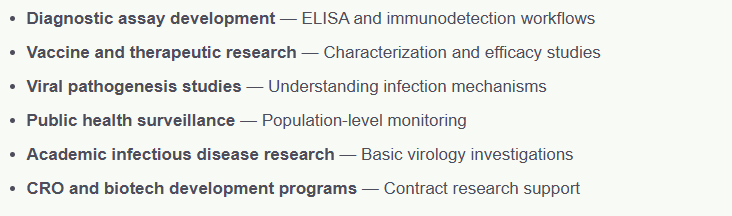 |
| During emerging infectious disease events, research timelines accelerate dramatically. Scientists need reagents that support rapid assay development, reproducibility, and reliable performance across multiple workflows. |
| ProSci's Commitment to Infectious Disease Research |
|
While outbreaks create serious global health challenges, they also highlight the critical importance of rapid scientific collaboration and access to dependable research tools. For over 28 years, ProSci has supported researchers working on emerging infectious diseases — from HIV and influenza to coronaviruses and filoviruses. ProSci remains committed to supporting the scientific community with high-quality antibodies and responsive service for emerging infectious disease research. To learn more about our infectious disease antibodies and research support capabilities explore ProSci Ebola antibody catalog. |
Come and meet us in Brescia!