
| September is World Alzheimer’s Month, a global campaign dedicated to raising awareness, challenging stigma, and accelerating the fight against dementia. As researchers worldwide unite to uncover the complex mechanisms behind cognitive decline, this month serves as a powerful reminder of the urgent need for reliable tools and innovative insights to drive the next generation of neurodegenerative breakthroughs. |

| StressMarq Biosciences is a leading provider of high-quality fibrillar, oligomeric, and monomeric protein preparations—including alpha synuclein, tau, amyloid beta, TDP-43, SOD1, TTR and more—designed to support cutting-edge neurodegenerative disease research. With a focus on pathology-inducing protein aggregates, our products support the development of robust disease models and accelerate drug discovery for conditions such as Alzheimer’s, Parkinson’s, and ALS. StressMarq is committed to scientific excellence— empowering researchers worldwide with tools that accelerate discovery and advance translational research. |
Amyloid Beta Pre-formed Fibrils (PFFs), Oligomers, & Monomers |
|
Amyloid beta (Aβ) is a peptide generated through proteolytic cleavage of amyloid precursor protein (APP) and is central to the pathology of Alzheimer’s disease (AD). In the brain, Aβ aggregates into soluble oligomers, protofibrils, and insoluble fibrils, ultimately forming extracellular plaques—a hallmark of AD. Soluble Aβ oligomers are particularly neurotoxic, impairing synaptic structure and function, and contributing to cognitive decline. Aβ has also been shown to interact with tau pathology and influence disease progression in Alzheimer’s and other neurodegenerative conditions, including Parkinson’s disease with dementia. StressMarq Biosciences offers a selection of amyloid beta constructs, including monomeric, oligomeric, and fibrillar forms, optimized for in vitro and in vivo research. These reagents support studies on aggregation kinetics, neurotoxicity, and drug discovery, helping researchers model disease mechanisms and accelerate our understanding of Alzheimer’s and related disorders. |
Product List | Amyloid Beta |
|
• Human Amyloid Beta Pyroglutamate 3-42 Pre-Formed Fibrils (PFFs) cat# SPR-492 • Human Amyloid Beta Peptide 1-40 Monomers cat# SPR-530 • Human Amyloid Beta Peptide 1-40 + C-term Cysteine Monomers cat# SPR-533 • Human Amyloid Beta 1-42 Pre-formed Fibrils (PFFs) cat# SPR-487 • Human Amyloid Beta 1-42 Oligomers cat# SPR-488 • Human Amyloid Beta Peptide 1-42 (HFIP monomeric) cat# SPR-485 |
Selected Scientific & Product Information |
Structure |
|
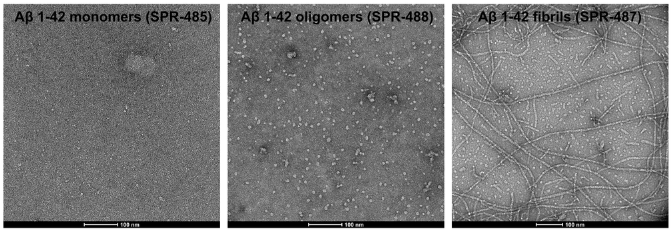
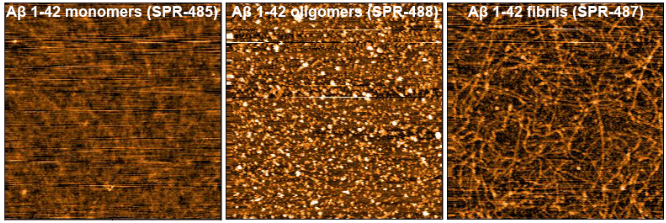
StressMarq’s amyloid beta peptide 1-42 (Aβ42) is produced synthetically and treated with 1,1,1,3,3,3-Hexafluoro-2-propanol (HFIP) prior to drying which breaks down pre-formed fibrils and monomerizes the peptide, as previously published (1,2). Our Amyloid Beta 1-42 (Aβ42) Oligomers and Amyloid Beta 1-42 (Aβ42) Pre-formed Fibrils (PFFs) are generated from this Amyloid Beta Peptide 1-42 (Aβ42) using a previously published method (1,2). Upon resuspension in Ammonium hydroxide (NH4OH), our Aβ42 presents as a monomeric peptide without fibrils when observed under TEM, AFM and on a Western Blot with an anti-amyloid beta antibody. StressMarq’s Aβ42 PFFs present as long strands when observed under TEM and AFM, and have a unique high molecular weight signal on a Western Blot with an anti-amyloid beta antibody. Our Aβ42 oligomers present as globular oligomers when observed under TEM and AFM, and have a unique dimer/trimer and oligomer signal on a Western Blot with an anti-amyloid beta antibody. |
TEM of amyloid beta 1-42 monomers (SPR-485, left), oligomers (SPR-488, middle) and fibrils (SPR-487, right). |
|
|
 |
AFM of amyloid beta 1-42 monomers (SPR-485, left), oligomers (SPR-488, middle) and fibrils (SPR-487, right). |
|
|
 |
Toxicity |
|
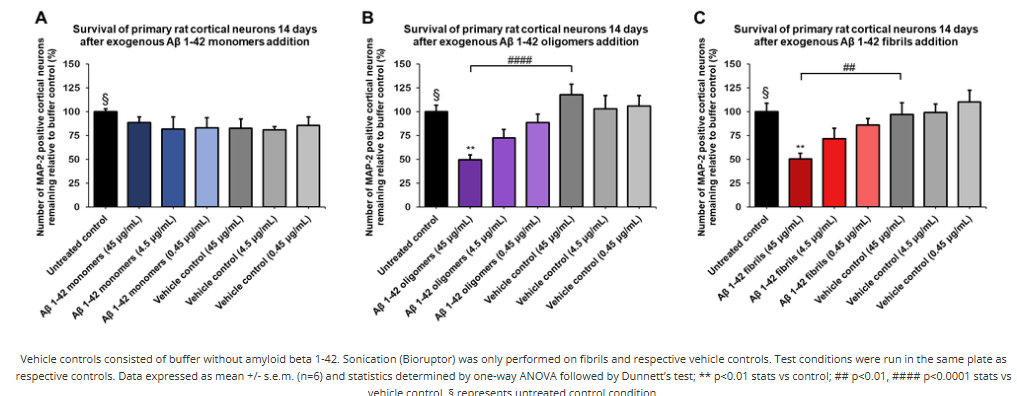
StressMarq’s Amyloid Beta 1-42 oligomers, pre-formed fibrils (PFFs) and monomeric peptide can be used for neurodegenerative disease research. Amyloid Beta 1-42 Oligomers (catalog# SPR-488) and Amyloid Beta 1-42 PFFs (catalog# SPR-487) show a dose-dependent toxicity to primary rat cortical neurons, whereas our Amyloid Beta 1-42 Peptide (monomeric) (catalog# SPR-485) does not show toxicity. The charts below show survival of rat primary cortical neurons 14 days after treatment with different concentrations of (A) monomers, (B) oligomers or (C) fibrils quantified by MAP2 positive neurons and expressed as a percentage of control. Fibrils and respective vehicle controls were initially sonicated in a Bioruptor. Test conditions were run in the same plate as untreated control and vehicle controls, which consisted of buffer without amyloid beta 1-42. |
|
|
 |
References1. Stine et al. 2003. JBC. 278(13):11612-22. doi: 10.1074/jbc.M210207200 |
Supplemental Learning Materials |
|
Technical Support Resources
Selected Media from the StressMarq YouTube Channel
Selected Articles from the StressMarq Blog
|
Come and meet us at FISV and BRAYN!